Guitar Quest (Relax Gaming) Slot Review
Play Guitar Quest on

K8 Casino

Rooli Casino

Ivibet Casino



Guitar Quest: Slot Overview
Rock slots usually mean a licensed band, a paint-by-numbers free spins round, and a soundtrack that gets old fast. Relax Gaming had a different idea when they dropped Guitar Quest in May 2026. This one pulls its DNA from Guitar Hero — the 2005 rhythm game where hitting the right notes at the right time built momentum toward something bigger. That concept bleeds into every layer of Guitar Quest’s design, from the way its Equalizer bonuses stack during the base game to the Guitar Hero-style Solo Mode that genuinely surprises the first time you see it.
What makes Guitar Quest stand out from branded rock releases like Sabaton or annihilator is that this game builds its own identity from scratch instead of borrowing someone else’s. Former CasinoDaddy streamer Oscar Ogge Persson had a hand in developing it — his second slot after Necromancer’s Gate — and you can feel a genuine enthusiasm for the source material running through the whole thing. It plays on a 5×4 grid with 1,024 ways to win, high volatility, and a max win of 10,000x. Experienced players who like their bonuses volatile and their base game unpredictable will find something worth plugging in here.
Design and Graphics
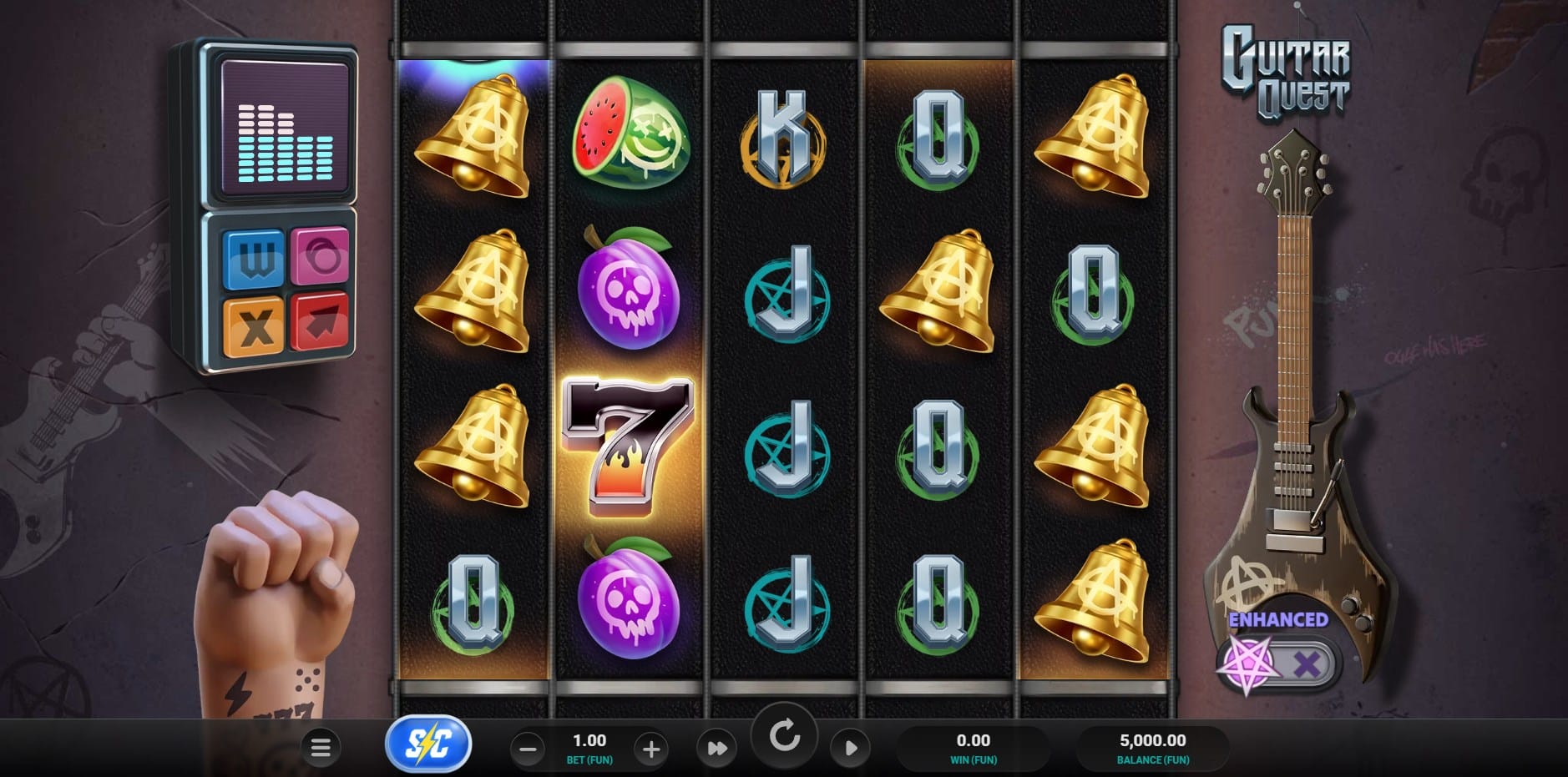
Guitar Quest skips the arena spectacle and sets itself up in the rehearsal space — the place where the hunger still lives. A guitar hangs on the wall. A disembodied arm punches the air mid-riff. Graffiti reads “Ogge Was Here.” It’s scrappy and self-aware, and it works better than a polished stadium backdrop would.
Guitar Quest slot – base game
That arm is a character in its own right. It bobs along with the spin results, reacts to wins, and carries more personality than most slot mascots manage with an entire animated body. It echoes Thing from The Addams Family, and whether that’s intentional or not, it sticks in the memory.
The symbol set commits fully to the theme without abandoning the classic structure. J, Q, K, and A royals get a heavy metal makeover with rough graffiti treatment. The premiums — plums, watermelons, cherries, bells, and a fiery 7 — keep the traditional slot DNA visible while fitting neatly into the rock aesthetic. Nothing here looks generic. The animations on wins are punchy and don’t overstay their welcome.
Where Guitar Quest really earns its visual marks is the Solo Mode screen. Coins and batteries tumbling down five reels toward a moving Collector Bar looks genuinely different from anything in a standard slot. The speed ramps up as the round progresses, and the escalating visual chaos matches the rising stakes perfectly. The looping metal soundtrack holds up well in short sessions. Grind it for hours and it will start to feel repetitive — but that’s true of most slots with a single core track.
Gameplay Mechanics
Five reels, four rows, 1,024 ways. You need matching symbols from left to right across adjacent reels to form a win. Standard enough setup, and the base game feels deceptively calm for the first few spins.
Then the Equalizer kicks in. At the start of any spin, there’s a chance that one to four Equalizer bonuses fire simultaneously. Wild Jam drops one to eight wilds onto reels two through five before any other symbols land. Twin Riff Split marks six to ten reel positions in advance and doubles any symbol that lands there — including wilds from Wild Jam, which is where things can get interesting fast. Fired Up Multiplier attaches a 2x to 10x win multiplier to the end result of that spin. Symbol Upgrade removes the four lowest-paying symbols entirely, leaving only the premium tier.
Any single one of these can turn an average spin into something worth paying attention to. All four at once makes the base game feel like a live performance hitting its peak. The catch is that this doesn’t happen on every spin. Far from it. Most spins are clean and uneventful, which is a deliberate design choice for a high-volatility game — the quiet stretches make the explosive moments land harder.
The base game paytable is lean. Five of the same royal symbol pays 1x the bet. Five of the best premium symbol pays 5x. Those numbers aren’t there to win the game alone. They exist to keep you spinning between the bigger triggers. The Equalizer and the bonus games carry the real weight.
Wilds substitute for all regular paying symbols. Scatters trigger the bonus pick. Three or more scatters land you at a choice between two very different bonus routes.
Bonus Features
Landing three or more scatter symbols opens a Bonus Pick screen where you choose your path. Three scatters give you the standard versions of each bonus. Four scatters unlock Super versions, and five scatters unlock Ultra. This matters because the starting conditions differ meaningfully between tiers, and so do the win potential profiles.
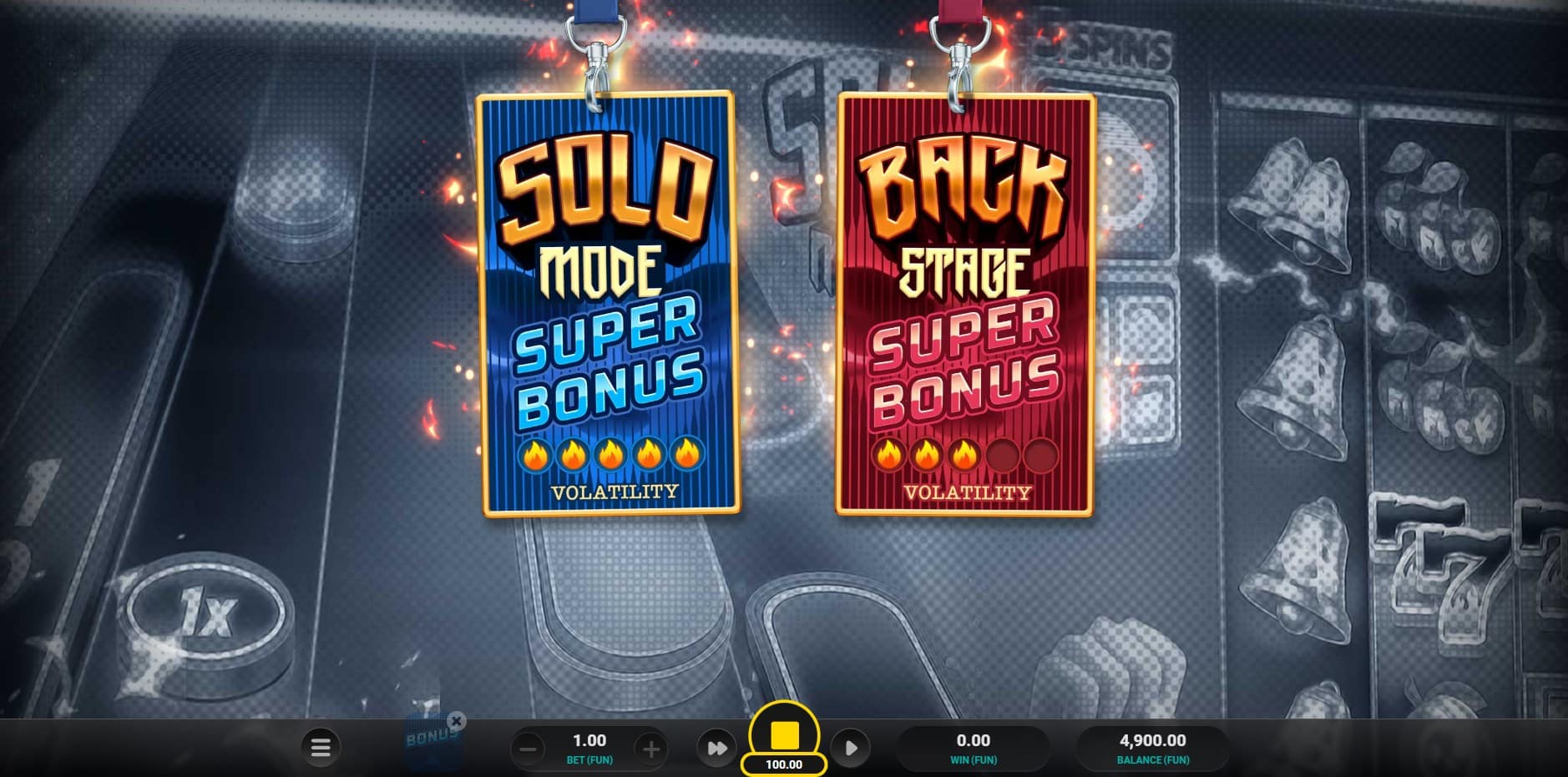
Guitar Quest slot – bonus pick
Backstage Bonus Game is the more traditional pick. Starting with eight spins (three scatters) or ten spins (four or five scatters), the active Equalizer bonuses from your trigger carry over and fire on every single spin. Each time you collect five scatters during the round, you unlock the next Equalizer in sequence — Twin Riff Split first, then Fired Up Multiplier, then Symbol Upgrade — and add five spins. Landing three scatters mid-round adds three spins. If all four Equalizers are already active, filling the meter still adds five spins. The progression system here builds genuine tension as you watch the meter creep toward the next unlock.
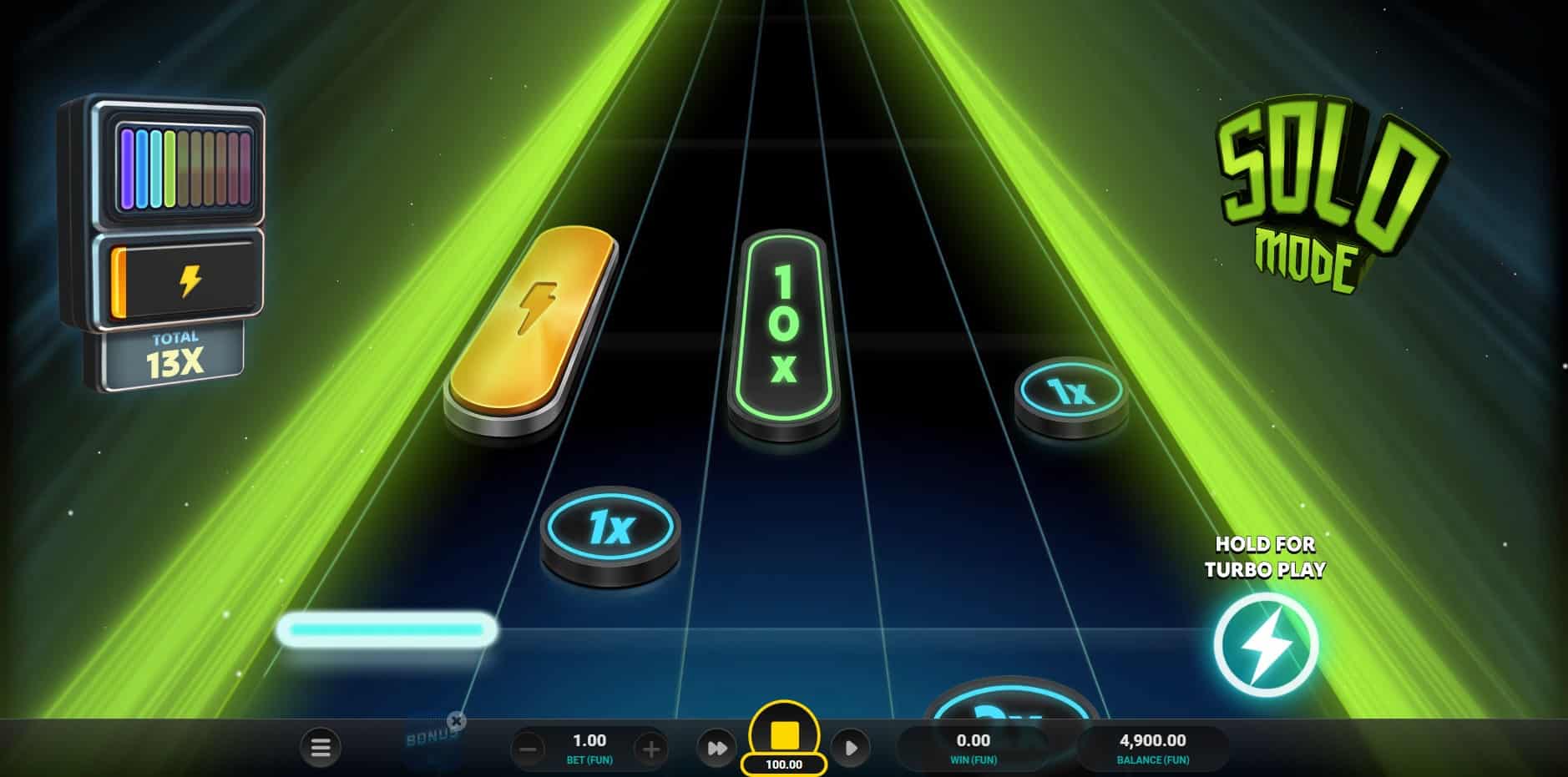
Guitar Quest slot – solo mode bonus
Solo Mode Bonus Game throws out the standard free spins format entirely. Prizes fall from the top of a five-reel grid toward a one-reel-wide Collector Bar that moves horizontally across the bottom. You collect whatever falls into its path. Coins range from Small (1x–5x) to Epic (1,000x the bet). Batteries refill the Energy Meter that keeps the round alive. Guitar God Boosters temporarily push higher-value coins onto the reels. Expander symbols stretch the Collector Bar across all five reels at once. The round levels up as it progresses, maxing at level 10. Speed increases with each level. When the Energy Meter empties, the round ends.
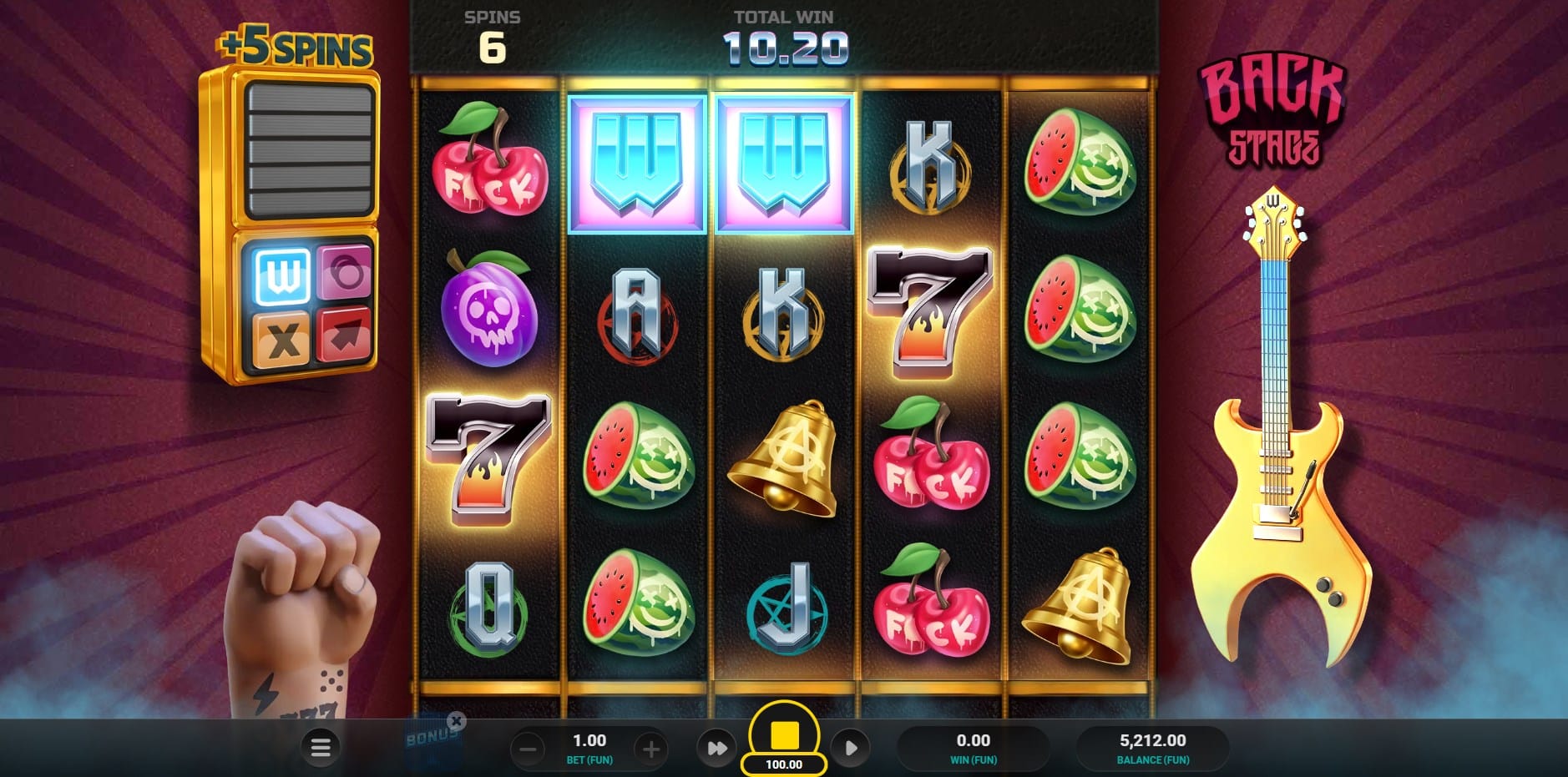
Guitar Quest slot – wild jam free spins
Solo Mode is genuinely unpredictable. One run can see the Collector Bar grazing Epic coins at level 8 while the energy bar stays topped up — a scenario that builds fast toward the 10,000x ceiling. The next run can see it crawling at low levels, barely snagging small coins. High volatility means both outcomes are completely plausible.
Both bonus games are selectable, which is a meaningful design choice. Backstage suits players who want structure and visible progression. Solo Mode suits players who want something with no ceiling on how wild it can get, and who don’t mind variance.
| Feature | Trigger | Details | Cost (Feature Buy) |
|---|---|---|---|
| Equalizer Bonuses (1–4) | Random at start of any base game spin | Wild Jam, Twin Riff Split, Fired Up Multiplier, Symbol Upgrade — any combination | 10x (1 guaranteed), 50x (2 guaranteed), 600x (all 4) |
| Backstage Bonus | 3+ scatters → Bonus Pick selection | 8–10 free spins with persistent Equalizers; unlock new Equalizers by collecting 5 scatters (+5 spins each) | 100x (standard), 400x (Ultra with 5 scatters) |
| Solo Mode Bonus | 3+ scatters → Bonus Pick selection | Collector Bar catches falling coins (1x–1,000x), batteries, boosters, and expanders; ends when Energy Meter empties | 100x (standard), 400x (Ultra) |
| Enhanced Spins (Ante Bet) | Player activation | 1.5x stake doubles bonus trigger chance; 10x stake activates Bonus Reels (scatters only on reels) | 1.5x or 10x current bet per spin |
Betting Options and Payouts
Bets run from €0.10 to €100 per spin, which covers most bankroll types. The RTP sits at 96.1% — solid for a high-volatility slot, and above the industry standard for this risk profile. What that number doesn’t tell you is how concentrated the return is in the bonus rounds. Base game wins are small and frequent enough to keep the session alive, but the real payout weight lives in the Equalizer combinations and, more aggressively, in Solo Mode.
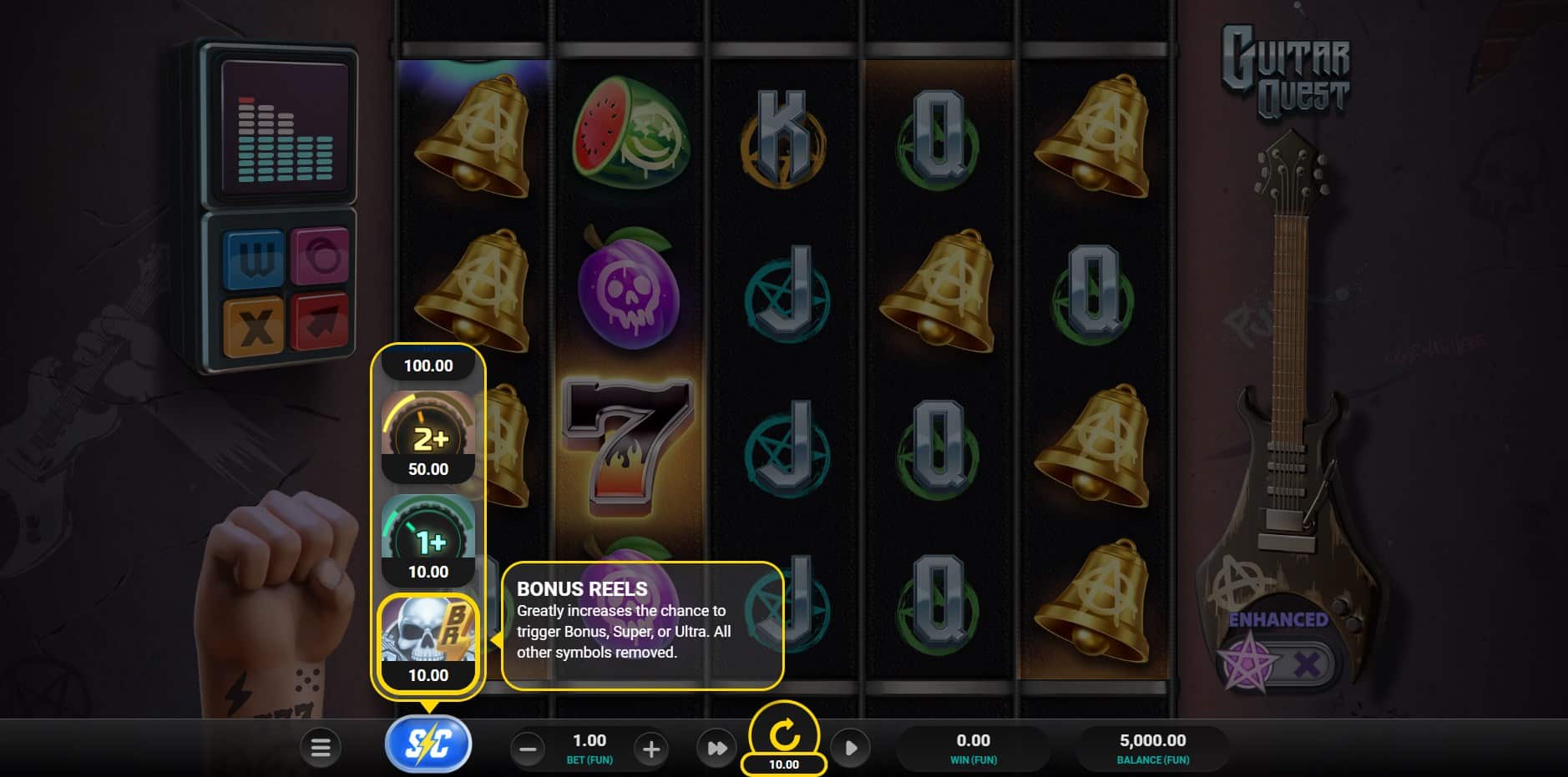
Guitar Quest slot – extra bet
High volatility here means exactly what it says. Long base game stretches without a significant Equalizer trigger are normal. When the Equalizer does stack all four modifiers, the win gap between that spin and the previous ten becomes obvious fast. Backstage hits with medium-to-high impact depending on how many Equalizers unlock. Solo Mode is the genuine high-volatility engine — capable of either delivering rapid multi-hundred-x results or plodding to a quiet end.
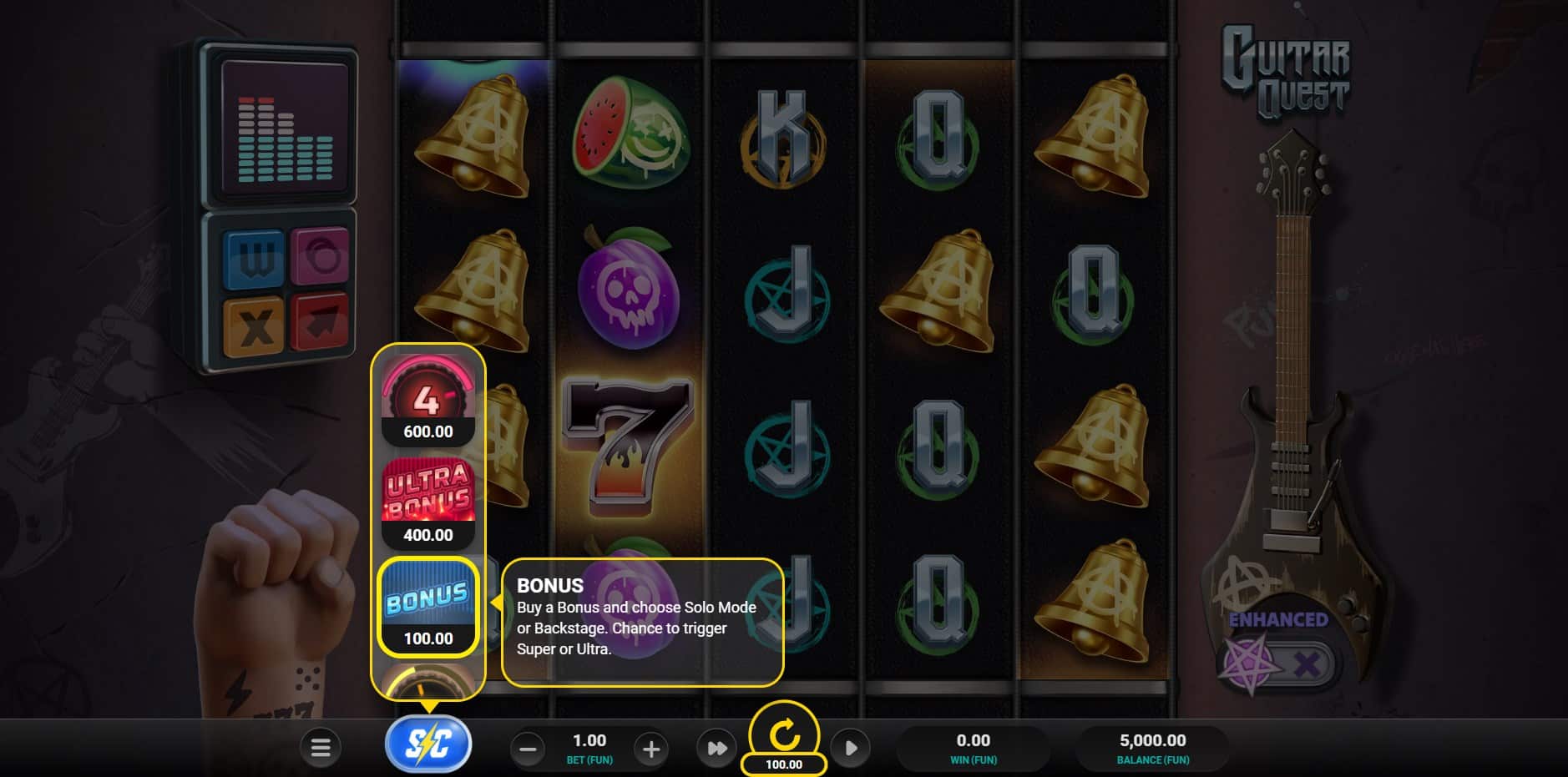
Guitar Quest slot – bonus buy
The hit frequency of 27.32% means roughly one in every four spins produces a win. That’s decent, but most of those wins will be small pay table returns from the base symbols. Don’t mistake frequent small hits for a cushioned ride — this is still a game where your bankroll can drop meaningfully before a bonus triggers.
The 10,000x max win is realistic only through Solo Mode at higher levels with optimal coin collection. Feature Buy options exist for players who want to bypass the base game grind entirely. Buying the Ultra Bonus at 400x is expensive but puts you straight into the highest-tier version of either bonus round. The 600x All-Four-Equalizers option is a niche play for a single guaranteed maximum-power spin.
| Spec | Detail |
|---|---|
| RTP | 96.1% |
| Volatility | High |
| Hit Frequency | 27.32% |
| Max Win | 10,000x bet |
| Min Bet | €0.10 |
| Max Bet | €100 |
| Paylines | 1,024 ways |
Conclusion
Guitar Quest does what most rock-themed slots don’t — it builds a genuine personality instead of renting one from a famous band. Relax Gaming and Ogge Persson have put together something that earns its theme rather than just decorating around it.
Solo Mode is the real reason to play this game. Nothing in its peer group looks quite like it, and when it runs hot — speed climbing, the Collector Bar catching Epic coins, batteries keeping the Energy Meter alive — it produces a kind of escalating tension that most free spins rounds can’t replicate. The Backstage Bonus is the dependable alternative for players who want structure and visible progression. Having both available from the same trigger and letting the player choose is genuinely smart design.
The weaknesses are real though. The base game paytable is thin. Without an Equalizer firing, most spins produce forgettable results. Players used to constant base game stimulation from something like gates of olympus or wanted dead or a wild will find the quiet stretches long. The Equalizer adds genuine variance when it stacks, but single-modifier spins rarely change the session’s direction on their own.
Play it if you enjoy high-volatility slots where the bonus round is the main event and you’re happy grinding for it. Solo Mode in particular suits players who’ve been chasing the kind of progressive energy found in Push Gaming‘s best work. Skip it if you need constant base game action to stay engaged — Guitar Quest saves its best material for the bonus stage.
Players can test the slot risk-free using the built-in demo available on this page.